



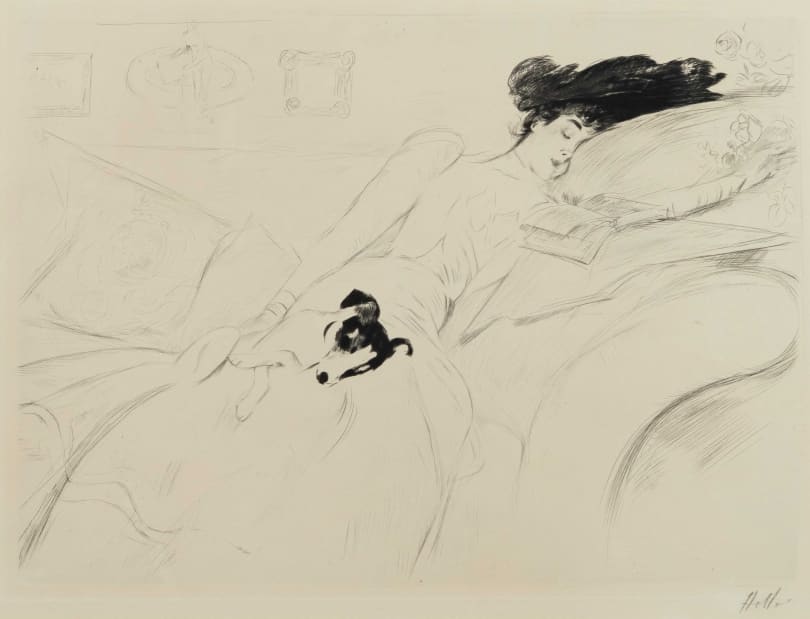
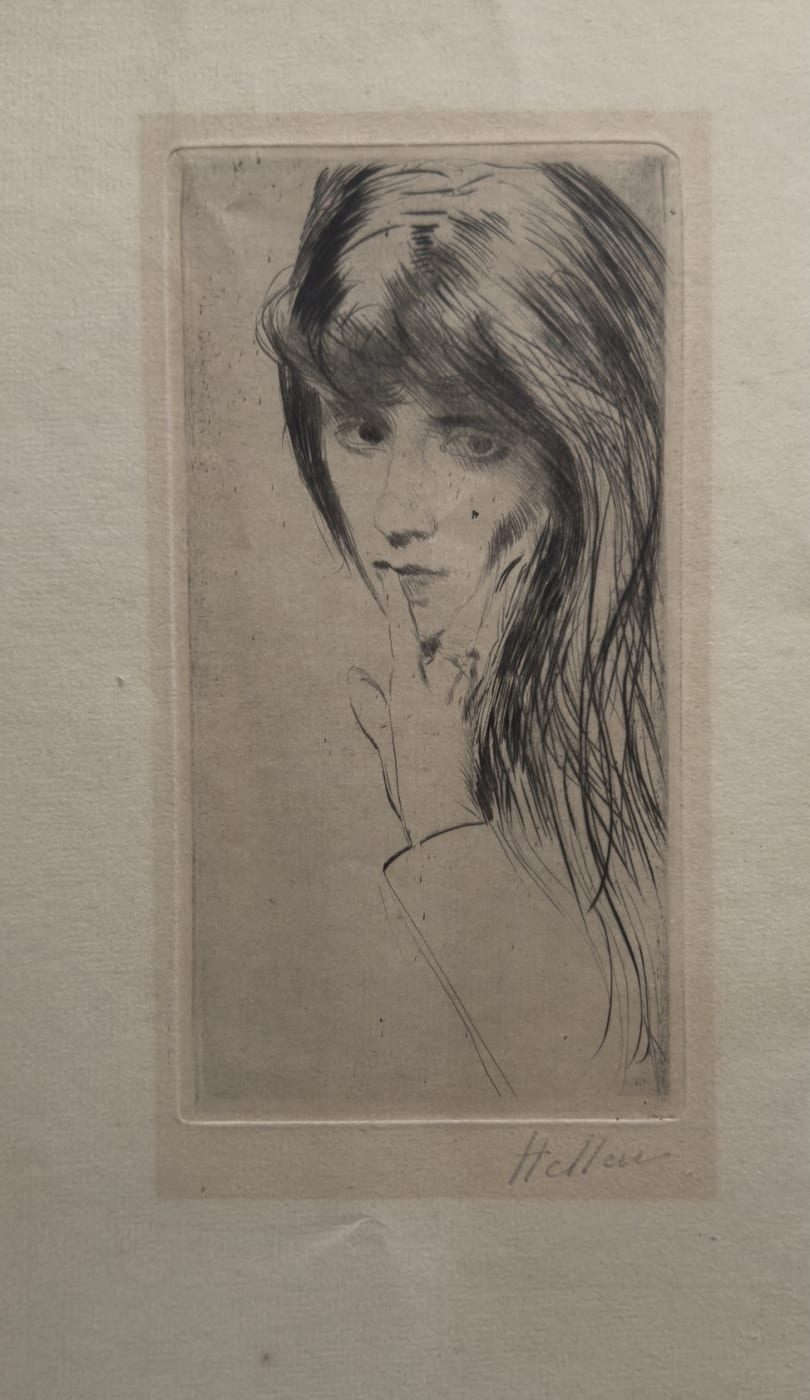
Femme aux cheveux longs
Category
PrintTechnique
DrypointDate
1892Dimensions
36.7 cm x 27.4 cm How does it work to buy on Art Shortlist ?
 Receive a price evolution alert
 Benefit from a delivery service
 I want to ask a question
Make an offer of
Artwork information
Category
PrintTechnique
DrypointDate
1892Dimensions
36.7 cm x 27.4 cmSignature
Signed lower rightProof(s) of authenticity
This work is recorded and included in the catalogue raisonné of Paul-César Helleu under number APCH PS1-2676.Its inclusion has been validated by the Association des Amis de Paul-César Helleu (APCH), whom we thank, thereby ensuring its full identification and its integration within the artist’s recognised body of work.
State of conservation
Good. Minor light staining and slight marginal foxing, not affecting the image.Framing
NoLocation
Paris, FranceDescription
Paul-César Helleu (1859–1927)
Woman with Long Hair
Circa 1892
Drypoint on paper
Signed “Helleu” in pencil, lower right
Dimensions
Sheet: 36.70 × 27.40 cm (14.45 × 10.79 in.)
Plate: 19.10 × 10.20 cm (7.52 × 4.02 in.)
In this rare drypoint, executed circa 1892, Helleu captures a young woman with loosened hair in a presence that is both immediate and elusive.
Barely contained within the plate mark, the figure seems to emerge from the surface of the paper, carried by a line of remarkable precision. The freely flowing hair becomes the central structural element of the composition, introducing a subtle tension between construction and abandon.
Through a masterful command of the drypoint technique, Helleu achieves a striking sense of immediacy: a few incisive lines are enough to suggest volume, light, and above all, life itself. Nothing is overstated, nothing is demonstrative. The work rests on a rare balance between economy of means and expressive intensity.
This drypoint was issued in an edition of only 10 impressions, making it particularly rare on the market.
Examples are held in major public collections, including:
- Musée d’art et d’histoire, Geneva (inv. E2019-0633, bequest of Jean Pozzi, 1971)
- Bibliothèque nationale de France, Paris (studio estate, gift of Paulette Howard-Johnston, 1957)
Provenance
French Private Collection
Bibliography
- Jean Adhémar, Jacques Lethève, Françoise Gardey, Inventaire du fonds français après 1800, t. 10, Paris, BnF, 1958, n°271, p. 213
- Bergeret-Gourbin, Imhoff, Paul Helleu 1859–1927, cat. exp., Musée Eugène Boudin, Honfleur, 1993, p. 62
Exhibition(s)
Musée Eugène Boudin, Honfleur, Paul Helleu 1859–1927, July 3 – October 4, 1993 (another impression from the edition of 10 was exhibited).
The artist

Bio
Paul-César Helleu's name evokes an era, and particularly a society from the end of the 19th century to the last years before the First World War in Europe, which Marcel Proust described so admirably in his works.
Delicacy, taste and his very personal talent as a draughtsman have largely contributed to the extraordinary success of this artist. His celebrity is based on the virtuoso representation of beautiful women from the great Parisian milieu, but also from the international society dominated by Anglo-Saxon elegance.
Today, the history of painting sums him up in representations that limit his talent too much to the fashion of a time, without taking into account a whole part of his artistic production devoted to the painting of nature, sea landscapes in particular, where refinement is in tune with the sensitive accents of a true artist.
Helleu was born in Vannes in 1859. On the death of his father, a customs inspector, he was sent to Paris to the Lycée Chaptal. In 1876, he was admitted to the École des Beaux-Arts de Paris in Jean-Léon Gérôme's studio, but it was mainly outdoor painters who attracted him. He became friends with Whistler and Sargent, then with Monet, whom he met at Durand-Ruel's during the second Impressionist Exhibition.
In order to survive, Helleu works for the ceramist Deck for whom he executes plate decorations. It was on this occasion that he met Giovanni Boldini, with whom he would share a very long friendship.
With Jacques-Émile Blanche, he shares a passionate taste for England since a trip to London in 1885. That same year, he tried his hand at engraving with a diamond point offered by James Tissot.
In 1884, Madame Guérin commissioned him to paint a portrait of her daughter Alice, then aged 14. He fell madly in love with her and married her two years later. The pastel, created for this occasion, as well as La Gare Saint-Lazare were presented at the 1885 Salon.
In 1886, having already been noticed in several exhibitions, he and his friend Monet refused to take part in the 8th Impressionist Exhibition despite Degas's requests. This is no doubt the reason why he was never part of the Impressionist movement, nor was he recognised as such. The following year, Robert de Montesquiou bought a lot of six engravings from him. From this meeting a deep friendship was born with the collector who put him in touch with his cousin, Countess Greffuhle. From that moment on, the artist entered Parisian society and became the fashionable portrait painter.
In 1893, Helleu began a series of stained-glass windows of cathedrals and, the following year, he changed his theme and lingered on the park of Versailles.
In 1897, he exhibited his paintings of Versailles and his seascapes at the Salon du Champ de Mars.
The artist was an innovator who attracted the admiration and curiosity of his contemporaries. In 1889, contrary to the pronounced taste of the time for dark interiors, he had the walls of his flat at 68 Bld Pereire painted white, followed by those of 45 rue Émile Ménier.
Helleu was soon in demand everywhere: he exhibited in London in 1895, where the exhibition catalogue, with a preface by Edmond de Goncourt, established his reputation. He then met Marcel Proust who was introduced to him by Montesquiou and began a deep relationship with him that would inspire the author to write the character of the painter Elstir in A la Recherche du Temps Perdu. Helleu engraved the portrait of Marcel Proust on his deathbed.
Like Elstir, Helleu is passionate about the sea. To the pleasure of the yachtsman, who spends most of his time on superb boats - he will own four of them - the painter discovers new sources of inspiration as much in the women's toilets as in his visions of the water and the sky, sometimes veiled, sometimes bluish.
The Helleu style, which characterises elegance or refinement and feminine grace, was a huge success in Paris, London and New York, where he travelled from 1902 onwards. He had great success in the United States with his portraits of elegant women and, in 1912, he was commissioned to paint the ceiling of the Hall of the Grand Central Station in New York with the theme of the signs of the zodiac: he composed a starry vault, crossed by a zodiac with gold signs and a silver milky way.
Helleu died in 1927, following an operation while he was planning a major exhibition of his paintings with Forain.
Les Amis de Paul-César Helleu, an association founded in 2001 by Paulette Howard-Johnston, the artist's daughter, has as its mission the protection, diffusion and promotion of the work of Paul-César Helleu. In 2020, thanks to a collective work carried out over several generations, Les Amis de Paul-César Helleu published the artist's digital catalog raisonné.
"The graceful Helleu painted in an unknown colour between delight and blue." Stéphane Mallarmé
Other artworks by Paul-César Helleu
See all artworks by Paul-César Helleu


You may also like
See all artworks


 Ludovic Thiriez





.jpg)
.jpg)













 Delivery Service