



Cage P19-4
Category
PrintTechnique
Giclée print on aluminium composite panelDate
2020Dimensions
100 cm x 100 cm How does it work to buy on Art Shortlist ?
 Receive a price evolution alert
 Benefit from a delivery service
 I want to ask a question
Make an offer of
Artwork information
Category
PrintTechnique
Giclée print on aluminium composite panelDate
2020Dimensions
100 cm x 100 cmSignature
UnsignedProof(s) of authenticity
The artwork is sold with a certificate of authenticity issued by HENI.State of conservation
Very goodFraming
YesLocation
Yangsan, South KoreaDescription
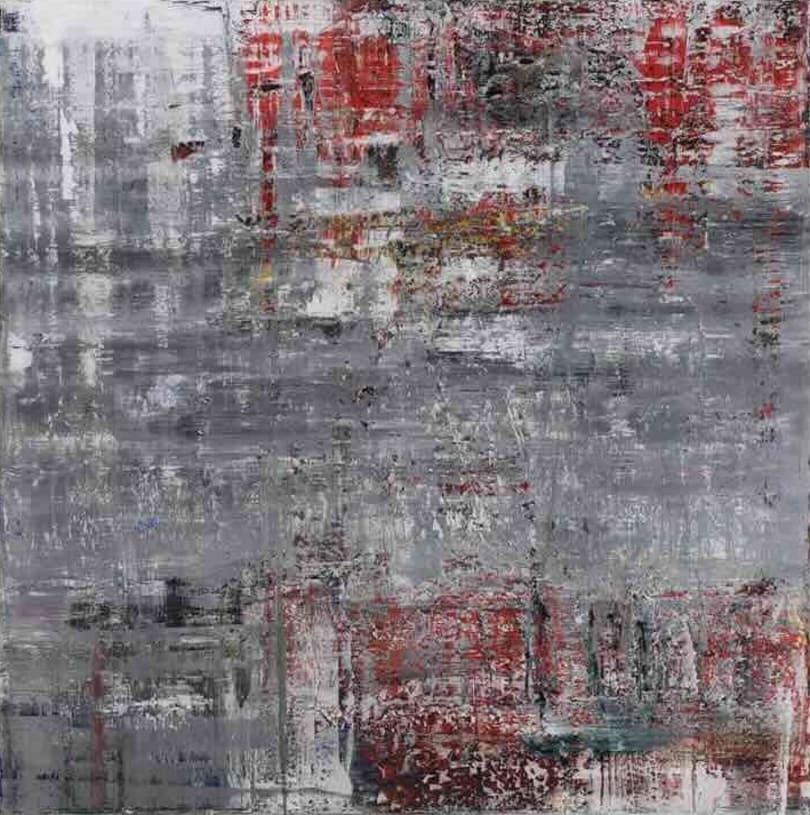
Gerhard Richter, Cage P19-4, 2020
Diasec-mounted giclée print on aluminium composite panel
100 × 100 cm
Edition of 200
Published by HENI
Numbered and stamped by the publisher on the label (verso)
Created in 2020, Cage P19-4 belongs to one of the most emblematic abstract series by Gerhard Richter, inspired by his cycle of Cage paintings produced between 2006 and 2007.
These works take their title from the American composer John Cage, a major figure of experimental music whose approach to chance and indeterminacy profoundly influenced Richter’s reflections on abstract painting.
In this composition, dominated by a palette of silvery greys, blacks and deep reds, Richter deploys his characteristic pictorial language: layered surfaces, scraped gestures, fragmented structures and dense textures. The result creates a complex pictorial space in which layers of colour appear and disappear beneath the surface.
The technique used by Richter in his abstract paintings relies on the use of large squeegees to drag paint across the canvas, generating unpredictable visual effects. This process combines artistic intention with accident, producing compositions of remarkable visual richness in which depth emerges through the transparency of successive layers.
The Cage edition published in 2020 by HENI faithfully translates these painterly effects through a very high-quality giclée printing process. The work is mounted using the Diasec technique, a museum-grade finishing method consisting of mounting the image beneath optically clear acrylic and fixing it onto an aluminium composite panel, ensuring exceptional stability and striking colour intensity.
This limited edition of 200 allows collectors to access Richter’s abstract universe in a contemporary format particularly suited for display in private collections or exhibition spaces.
The Cage series in Gerhard Richter’s work
The Cage series occupies an important place in Richter’s career. The original paintings were created in 2006 and are now held in several major institutional collections.
In 2011, they were the subject of a major exhibition at the Tate Modern in London, dedicated to these monumental works exploring the tensions between structure and chaos.
The editions published by HENI continue this research and are widely recognised for their production quality, the publisher working directly with artists or their studios to produce editions faithful to the original works.
An emblematic work of contemporary abstraction
Through Cage P19-4, Richter continues a fundamental exploration of contemporary painting: how to create an image that escapes the artist’s total control while remaining deeply intentional.
The result is a work in which the materiality of paint, gestural accidents and chromatic layering produce a dense, almost architectural visual experience. The contrasts between metallic greys and flashes of red reinforce this tension between structure and dissolution.
This piece perfectly illustrates the unique place of Gerhard Richter in the history of contemporary art, at the crossroads of abstraction, experimentation and reflection on the nature of the image.
Provenance
HENI
The artist

Bio
Gerhard Richter, born in 1932 in Dresden, Germany, is widely regarded as one of the most influential artists of contemporary art and one of the most important painters on the international art scene. His work, spanning more than six decades, explores the complex relationships between figuration, abstraction, photography and memory while questioning the very nature of the image.
Richter studied at the Academy of Fine Arts in Dresden in the 1950s, when the city was part of East Germany. His artistic training took place in a context dominated by socialist realism, which provided him with a strong academic foundation centered on figurative and monumental painting. In 1961, shortly before the construction of the Berlin Wall, he left East Germany and moved to West Germany, where he continued his studies at the Kunstakademie Düsseldorf. It was within this particularly dynamic artistic environment that he met artists such as Sigmar Polke and Konrad Lueg. Together they contributed to the development of the concept of “Capitalist Realism,” a critical response to American Pop Art and the ideological systems of the time.
From the early 1960s onward, Richter developed a series of paintings based on photographs, which later became known as “photo-paintings”. These works reinterpret images drawn from personal photographs, newspapers and historical archives. Richter then painted them while applying his characteristic blur effect. This technique deliberately blurs the boundary between painting and photography and questions the way images shape our perception of reality and history.
From the late 1970s onward, Richter simultaneously deepened a major exploration of abstraction. His large abstract compositions are often created using wide squeegees that allow him to drag and layer paint across the surface. This technique introduces a significant degree of unpredictability into the creative process, combining control and chance. The resulting surfaces reveal remarkable visual depth, with colors appearing and disappearing beneath successive layers of paint.
Richter’s work is now held in some of the most important museums in the world, including the Tate Modern in London, the Museum of Modern Art in New York, the Centre Pompidou in Paris and the Neue Nationalgalerie in Berlin. Major retrospectives dedicated to his work have reinforced his central position in the history of contemporary art.
On the art market, Gerhard Richter is also among the most sought-after living artists. Several of his abstract paintings have achieved remarkable results at auction, including Abstraktes Bild (1986), which sold for more than 46 million dollars in 2015. These results confirm the importance of his work among international collectors and major institutions.
Throughout his career, Richter has explored a wide range of mediums including painting, photography, glass, printmaking and editions. This diversity reflects a constant reflection on the nature of images and the limits of representation. By combining formal experimentation with philosophical inquiry, Gerhard Richter has built a major body of work that continues to exert a profound influence on contemporary art and on the way painting is understood today.
You may also like
See all artworks


 Ludovic Thiriez





.jpg)
.jpg)













 Delivery Service