



Portrait of a Lovely Six Foota #1
Category
PrintTechnique
Giclée print on paperDate
2009Dimensions
35.6 cm x 27.9 cm How does it work to buy on Art Shortlist ?
 Receive a price evolution alert
 Benefit from a delivery service
 I want to ask a question
Make an offer of
Artwork information
Category
PrintTechnique
Giclée print on paperDate
2009Dimensions
35.6 cm x 27.9 cmDimensions with frame43 cm x 35 cm
Signature
Signed on the backProof(s) of authenticity
The artwork is sold with a certificate of authenticity issued by the Santa Monica Museum of Art (SMMoA), in collaboration with the artist.State of conservation
Very goodFraming
YesLocation
Yangsan, South KoreaDescription
Mickalene Thomas, Portrait of a Lovely Six Foota #1, 2009
Giclée print on paper
Edition of 50
Dimensions
Image: 35.6 × 27.9 cm (14 × 11 in.)
Framed: 43 × 35 cm (16.9 × 13.8 in.)
Certificate of authenticity issued by the Santa Monica Museum of Art (SMMoA), in collaboration with the artist
Numbered: 40/50
Created in 2009, Portrait of a Lovely Six Foota #1 belongs to a pivotal moment in Mickalene Thomas’s practice, marked by the full emergence of her visual language and core themes.
This print embodies the artist’s signature approach: a direct, frontal portrait in which the female figure fully occupies the space and asserts her presence. The gaze is steady, confident, almost confrontational. Every element of the composition is carefully constructed, leaving nothing to chance.
The surface, visually dense, evokes the effect of Mickalene Thomas’s characteristic materials—rhinestones, decorative patterns, and layered textures—here translated into the medium of print. The treatment of the garment, in particular, reflects this ornamental richness, engaging both with art historical references and African American visual culture.
The background and decorative elements are never secondary. They actively contribute to a carefully staged composition in which identity is constructed as much through the environment as through the figure itself.
Analysis
Through this work, Mickalene Thomas continues her essential practice of reconfiguring the representation of the Black female body within art history.
The title itself, Lovely Six Foota, already suggests a form of physical and symbolic assertion. This is not a passive portrait, but a constructed presence, fully aware of itself and of its image.
By reworking the conventions of Western portraiture, the artist proposes a new visual language in which Black women are no longer objects of the gaze, but sovereign subjects.
This tension between decorative aesthetics and political strength lies at the core of her work.
Significance within the artist’s practice
The year 2009 marks a significant phase of expansion in Mickalene Thomas’s career, just before her major institutional recognition in the early 2010s.
The editions produced in collaboration with the Santa Monica Museum of Art reflect a moment when her work began to circulate more widely, while maintaining a strong commitment to quality and controlled distribution.
Market and positioning
Mickalene Thomas’s editions, particularly those produced with institutions such as the SMMoA, are highly sought after due to their production quality, limited edition size, and their positioning within a key moment of the artist’s career.
Her market has shown consistent growth over the past decade, supported by strong institutional recognition and increasing international demand.
Provenance
Santa Monica Museum of Art (SMMoA)
The artist

Bio
Mickalene Thomas, born January 28, 1971, in Camden, New Jersey, is a leading contemporary American artist whose work has become central to the redefinition of Black female representation in art. Through painting, collage, photography, and installation, she has developed a distinctive visual language that is both formally striking and deeply rooted in cultural and political discourse.
She studied at the Pratt Institute in Brooklyn, where she earned her Bachelor of Fine Arts in 2000, before completing a Master of Fine Arts at the Yale School of Art in 2002. Early in her career, her participation in the Studio Museum in Harlem residency program played a pivotal role in establishing her presence within a new generation of influential African American artists.
Mickalene Thomas is known for her layered and materially rich compositions. She combines acrylic paint, enamel, collage, textiles, and rhinestones to produce works that challenge traditional distinctions between fine art and decorative aesthetics. Her visual language draws heavily from 1970s interior design, photography, and popular culture, while maintaining a critical dialogue with canonical Western art history.
Her 2010 work Le Déjeuner sur l’herbe: Les Trois Femmes Noires marked a major breakthrough. By reinterpreting Édouard Manet’s iconic composition and replacing its figures with contemporary Black women, she reclaims both space and narrative within art history. This approach reflects her broader practice, which seeks to reposition Black female bodies at the center of visual culture.
Her work consistently addresses themes of identity, representation, desire, and the politics of the gaze. Often inspired by people close to her, including her mother Sandra Bush, her portraits present women as self-possessed, powerful subjects rather than passive figures.
Mickalene Thomas has exhibited widely in major institutions, including the Museum of Modern Art in New York, the Brooklyn Museum, the Whitney Museum of American Art, and the Tate Modern in London. Her works are held in prominent public and private collections worldwide, reinforcing her status as a key figure in contemporary art.
Her market has grown steadily since the 2010s, with increasing demand from collectors and institutions. Her rise aligns with a broader reassessment of the place of women and African American artists within the global art market.
Beyond its visual impact, Mickalene Thomas’s work plays a critical role in reshaping art historical narratives. By challenging established representations and proposing new forms of visibility, she stands today as one of the most important voices in contemporary art.
Other artworks by Mickalene Thomas
See all artworks by Mickalene Thomas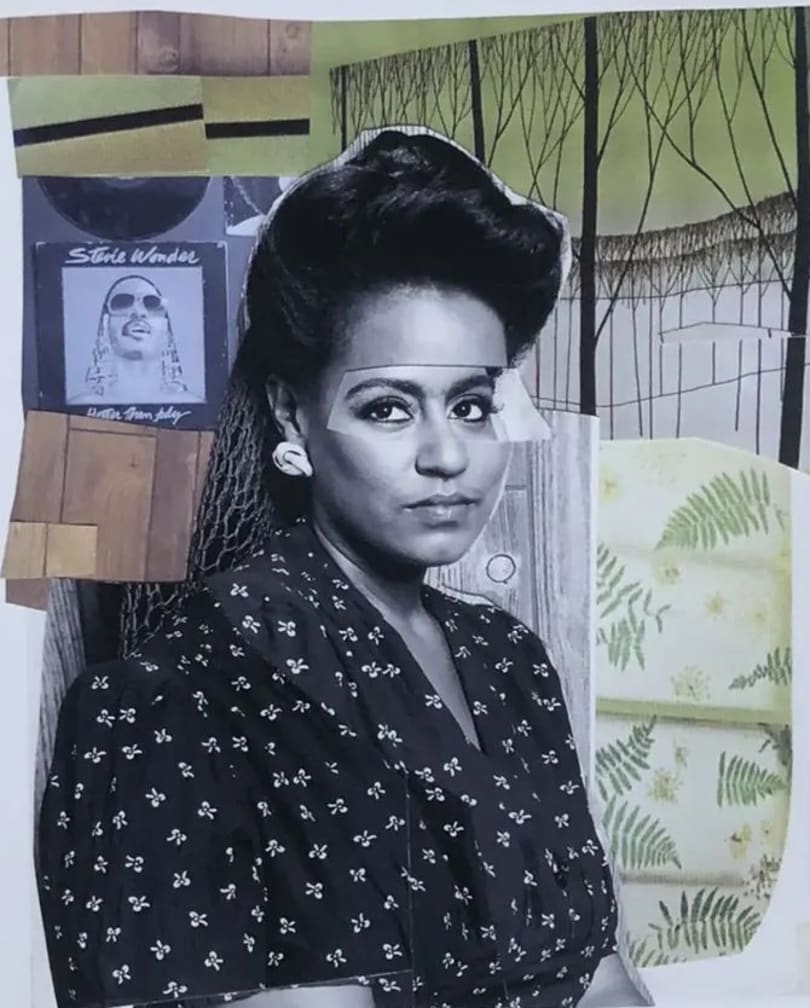
You may also like
See all artworks
 Shepard Fairey (OBEY)







.jpg)
.jpg)
















 Delivery Service