



Madame Helleu à la harpe
Category
PrintTechnique
DrypointDate
1898Dimensions
63.1 cm x 44.9 cm How does it work to buy on Art Shortlist ?
 Receive a price evolution alert
 Benefit from a delivery service
 I want to ask a question
Make an offer of
Artwork information
Category
PrintTechnique
DrypointDate
1898Dimensions
63.1 cm x 44.9 cmSignature
Signed lower leftProof(s) of authenticity
The authenticity of this work has been confirmed by the Association des Amis de Paul-César Helleu and it is listed in the Digital Catalogue Raisonné under reference APCH PS1-1009.State of conservation
Sheet in excellent overall condition, with slight lightening which does not affect the legibility of the work or its aesthetic quality.Framing
NoLocation
Paris, FranceDescription
Paul-César Helleu (1859–1927)
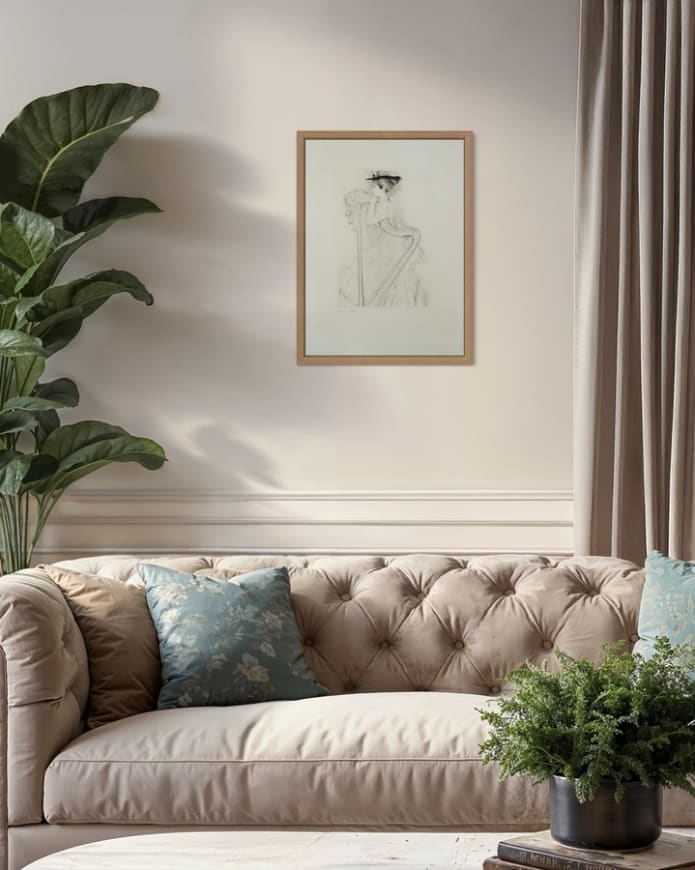
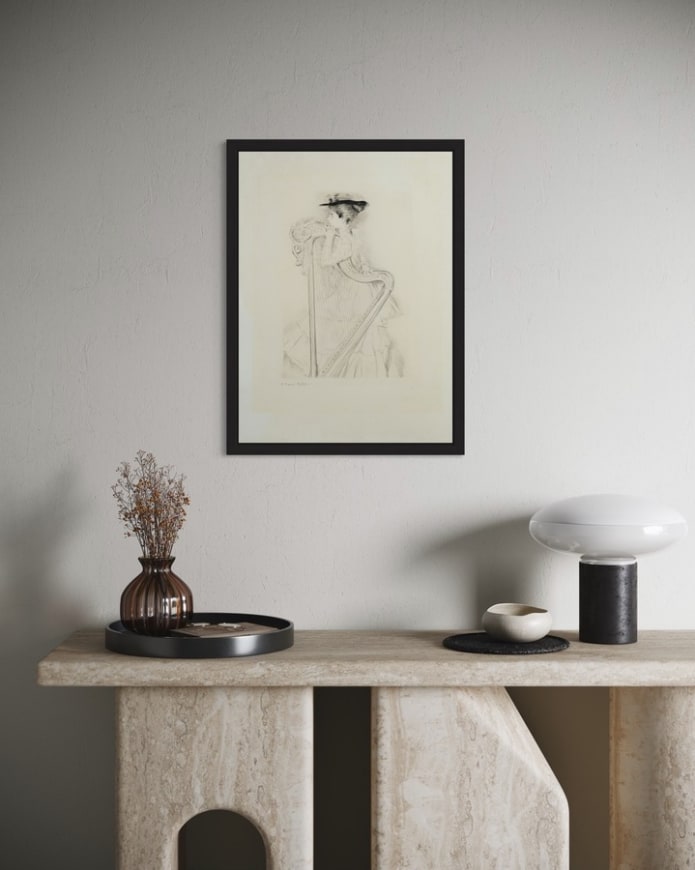
Madame Helleu at the Harp, 1898
Drypoint on copper printed on paper
Sheet: 63.1 × 44.9 cm (24.8 × 17.7 in)
Plate: 39.5 × 27.7 cm (15.6 × 10.9 in)
Work listed in the Digital Catalogue Raisonné of Paul-César Helleu under reference APCH PS1-1009.
Signed and inscribed “A Vimar” in pencil lower left. Early impression on fine paper, mounted in a modern mat.
In this masterful drypoint, Paul-César Helleu depicts Madame Helleu leaning against a harp, shown in profile, her hand resting on the instrument with natural elegance. The young woman, wearing a large hat, is captured in an attitude both graceful and focused, which encapsulates Helleu’s ideal of femininity: delicacy of the features, slender silhouette, refinement of gesture.
The virtuosity of the drypoint technique is fully evident here: the lines, at times silky, at times nervous, modulate the light without heaviness or excess. The harp strings, the dress, and the hair swept up are rendered through a network of incredibly precise strokes, made possible by the famous diamond-tipped stylus on copper introduced to Helleu by his friend James Tissot. This technique allows for a supple line of exceptional intensity, giving the print an almost tactile presence.
The economy of means—only black ink on the white of the paper—enhances the elegance of the composition: everything rests on the quality of the line and the control of tonal values. The viewer’s gaze is led by the diagonal of the harp, which naturally guides the eye towards Madame Helleu’s face, the true emotional centre of the print.
Historical and artistic context
As a printmaker no less important than a painter, Paul-César Helleu is regarded as one of the great masters of drypoint at the turn of the 19th to the 20th century. From the late 1880s onwards, encouraged by James Tissot, he adopted the diamond-point needle to incise the copper plate directly. This demanding technique enabled him to achieve a line that is at once deep, velvety and incredibly sensitive—ideal for conveying the movement of hair, the suppleness of a silhouette or the shimmer of fabrics.
Critics of his time, from Goncourt to Mirbeau, emphasised the uniqueness of his prints, which capture “the moment of grace” of the women around him. Madame Helleu at the Harp fits perfectly within this vein: it is one of those intimate portraits in which the artist succeeds in bringing technical virtuosity and restrained emotion into perfect harmony.
Executed in 1898, this work belongs to the most sought-after period of Helleu’s drypoints, when the artist was ceaselessly portraying his wife and muse, Alice, in poses that epitomise the art of living of the Belle Époque: musicality, intimacy, grace and modernity.
Several impressions of this drypoint are held in major public collections, including:
- Musée Bonnat-Helleu, Bayonne, France (gift of Paulette Howard-Johnston, 1988)
- Bibliothèque nationale de France, Paris, France (Donation, 1943)
The presence of this subject in such public collections underlines its importance within Helleu’s printed œuvre.
Commentary on the work
By virtue of its condition, the handwritten dedication, the freshness of the impression and the importance of its subject, Madame Helleu at the Harp ranks among the most accomplished and desirable drypoints by the artist. The combination of an emblematic subject (Madame Helleu), a technique brought to its highest refinement and a strong critical pedigree makes it a reference work for any collector of Helleu or of Belle Époque prints.
Provenance
French private collection
Bibliography
- Catalogue Bibliothèque Nationale, Paris, 1957, p. 24.
- Le Figaro illustré, numéro spécial « La femme par Helleu », no. 115, October 1899, p. 219.
- Inventaire du fonds français après 1800, Jean Adhémar, Jacques Lethève, Françoise Gardey, tome 10, Paris, Bibliothèque nationale, 1958, no. 255, p. 211.
- Paul Helleu drypoints, exh. cat., Galerie Lumley Cazalet Ltd, London, 25 June – 24 July 1992, no. 21.
- Paul Helleu, Drypoints, Lumley Cazalet Ltd, London, 12 June – 31 July 1970, no. 25.
- The Graphic, supplement (illustration reference).
Sales catalogues
- Maîtres Pescheteau-Badin, Godeau, Leroy, De Ricqlès, Paris, Drouot, 28 November 1999, lot 109.
- Piasa, Paris, 23 November 2011, lot 163.
Exhibition(s)
Galerie Jean Charpentier, Paris, France, 3 November – 17 November 1931.
Imagine the artwork at home



The artist

Bio
Paul-César Helleu's name evokes an era, and particularly a society from the end of the 19th century to the last years before the First World War in Europe, which Marcel Proust described so admirably in his works.
Delicacy, taste and his very personal talent as a draughtsman have largely contributed to the extraordinary success of this artist. His celebrity is based on the virtuoso representation of beautiful women from the great Parisian milieu, but also from the international society dominated by Anglo-Saxon elegance.
Today, the history of painting sums him up in representations that limit his talent too much to the fashion of a time, without taking into account a whole part of his artistic production devoted to the painting of nature, sea landscapes in particular, where refinement is in tune with the sensitive accents of a true artist.
Helleu was born in Vannes in 1859. On the death of his father, a customs inspector, he was sent to Paris to the Lycée Chaptal. In 1876, he was admitted to the École des Beaux-Arts de Paris in Jean-Léon Gérôme's studio, but it was mainly outdoor painters who attracted him. He became friends with Whistler and Sargent, then with Monet, whom he met at Durand-Ruel's during the second Impressionist Exhibition.
In order to survive, Helleu works for the ceramist Deck for whom he executes plate decorations. It was on this occasion that he met Giovanni Boldini, with whom he would share a very long friendship.
With Jacques-Émile Blanche, he shares a passionate taste for England since a trip to London in 1885. That same year, he tried his hand at engraving with a diamond point offered by James Tissot.
In 1884, Madame Guérin commissioned him to paint a portrait of her daughter Alice, then aged 14. He fell madly in love with her and married her two years later. The pastel, created for this occasion, as well as La Gare Saint-Lazare were presented at the 1885 Salon.
In 1886, having already been noticed in several exhibitions, he and his friend Monet refused to take part in the 8th Impressionist Exhibition despite Degas's requests. This is no doubt the reason why he was never part of the Impressionist movement, nor was he recognised as such. The following year, Robert de Montesquiou bought a lot of six engravings from him. From this meeting a deep friendship was born with the collector who put him in touch with his cousin, Countess Greffuhle. From that moment on, the artist entered Parisian society and became the fashionable portrait painter.
In 1893, Helleu began a series of stained-glass windows of cathedrals and, the following year, he changed his theme and lingered on the park of Versailles.
In 1897, he exhibited his paintings of Versailles and his seascapes at the Salon du Champ de Mars.
The artist was an innovator who attracted the admiration and curiosity of his contemporaries. In 1889, contrary to the pronounced taste of the time for dark interiors, he had the walls of his flat at 68 Bld Pereire painted white, followed by those of 45 rue Émile Ménier.
Helleu was soon in demand everywhere: he exhibited in London in 1895, where the exhibition catalogue, with a preface by Edmond de Goncourt, established his reputation. He then met Marcel Proust who was introduced to him by Montesquiou and began a deep relationship with him that would inspire the author to write the character of the painter Elstir in A la Recherche du Temps Perdu. Helleu engraved the portrait of Marcel Proust on his deathbed.
Like Elstir, Helleu is passionate about the sea. To the pleasure of the yachtsman, who spends most of his time on superb boats - he will own four of them - the painter discovers new sources of inspiration as much in the women's toilets as in his visions of the water and the sky, sometimes veiled, sometimes bluish.
The Helleu style, which characterises elegance or refinement and feminine grace, was a huge success in Paris, London and New York, where he travelled from 1902 onwards. He had great success in the United States with his portraits of elegant women and, in 1912, he was commissioned to paint the ceiling of the Hall of the Grand Central Station in New York with the theme of the signs of the zodiac: he composed a starry vault, crossed by a zodiac with gold signs and a silver milky way.
Helleu died in 1927, following an operation while he was planning a major exhibition of his paintings with Forain.
Les Amis de Paul-César Helleu, an association founded in 2001 by Paulette Howard-Johnston, the artist's daughter, has as its mission the protection, diffusion and promotion of the work of Paul-César Helleu. In 2020, thanks to a collective work carried out over several generations, Les Amis de Paul-César Helleu published the artist's digital catalog raisonné.
"The graceful Helleu painted in an unknown colour between delight and blue." Stéphane Mallarmé
Other artworks by Paul-César Helleu
See all artworks by Paul-César Helleu


You may also like
See all artworks


 Ludovic Thiriez





.jpg)
.jpg)













 Delivery Service