4 min
4 minCould AI be rewriting centuries of art history?
A Swiss artificial intelligence system has just attributed a painting long dismissed as a copy to the hand of Caravaggio himself. The case of The Lute Player reignites the debate over whether algorithms can truly authenticate works of art and challenges the authority of traditional expertise in the art world.

A long-dismissed Caravaggio copy resurfaces
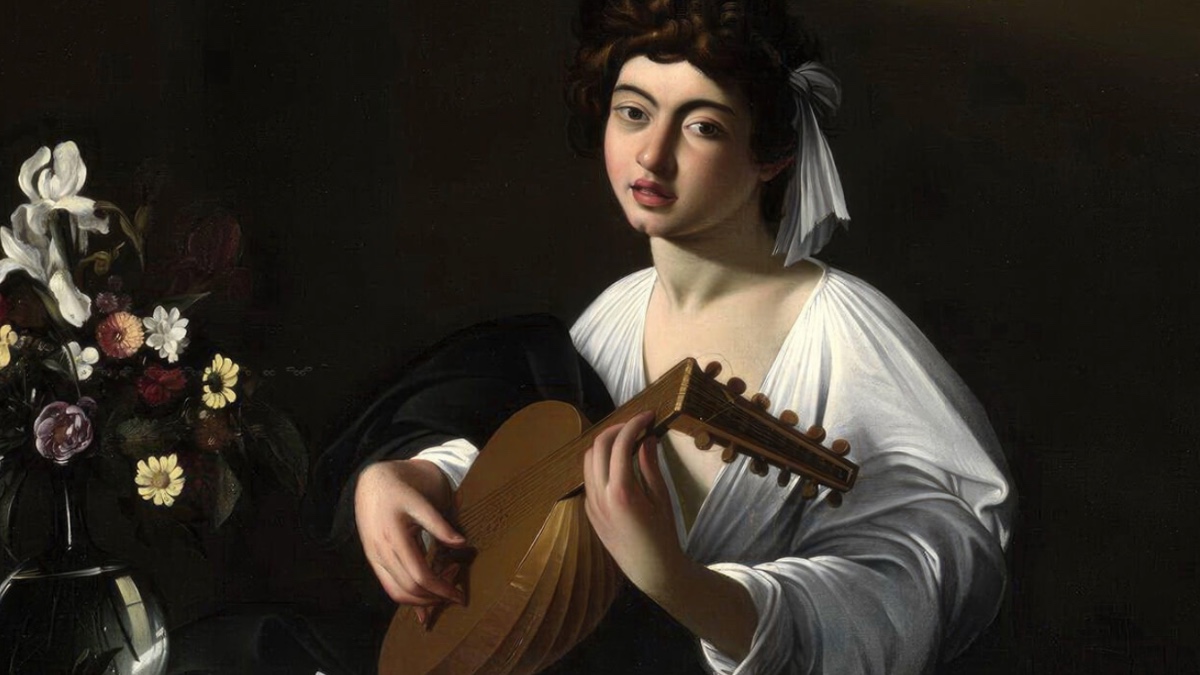
The Lute Player, Caravaggio (according to AI), 1596
For centuries, the Lute Player once owned by the Duke of Beaufort remained in the shadows. Considered a replica painted around 1642 by Carlo Magnone, it sold for the equivalent of €860 at a 1969 Sotheby’s auction.
When it resurfaced in 2001, described as a work from the circle of Caravaggio, it was purchased by art historian and dealer Clovis Whitfield for €80,000, a fraction of what an authentic Caravaggio would command today.
Most scholars, including Keith Christiansen of the Metropolitan Museum of Art, continued to classify it as a copy. But everything changed when artificial intelligence entered the picture.
AI enters the scene
Founded in 2019, the Swiss company Art Recognition has developed an algorithm capable of comparing a painting’s visual features with vast databases of known works.
In partnership with the University of Liverpool, researchers analyzed high-resolution images of the Lute Player from Badminton House, comparing them with over 200 paintings by Caravaggio and his contemporaries.
The result: an 85.7% probability that the work is by Caravaggio himself, a "very high" score according to Carina Popovici, the company’s director.
She noted that the stylistic correspondences were "clearly consistent with Caravaggio’s hand."
The finding shook long-standing consensus. The AI even questioned the authenticity of the Wildenstein version, long accepted as genuine, while confirming the Hermitage version in St. Petersburg as unquestionably autograph.
Between science and subjectivity
These results have reignited a crucial question: Can a machine truly decide what is genuine in art? AI doesn’t "discover", it calculates probabilities based on data. Its accuracy depends on the quality of the images, the range of comparisons, and the training set it has been fed.
As Art Recognition’s team puts it: an algorithm is only as good as what it has learned to see.
Others, however, see AI as a new form of methodological support, not a rival to experts, but a tool that adds another layer of precision to connoisseurship.
A turning point for the art market
If confirmed, this new attribution could transform the painting’s value overnight, from tens of thousands to tens of millions of euros.
But beyond the sensational case itself, this event opens a door: hundreds of artworks currently listed as "copies" could be re-examined in light of AI analysis.
For collectors, this means hidden treasures might resurface. For auction houses, it poses new challenges of interpretation. And for museums, it offers a powerful opportunity to reassess their holdings through fresh eyes.
Towards a new form of expertise
The Lute Player case marks a pivotal moment in the history of art authentication. On one side stands centuries of human expertise, intuition, and the cultivated "eye". On the other, an artificial intelligence capable of detecting thousands of visual nuances invisible to humans.
Rather than opposition, this is likely a new alliance between human sensitivity and algorithmic analysis. The authentication process of the future will probably be hybrid: guided by data, refined by intuition.