5 min
5 minWe often hear that painting is over, that it can no longer move us. The George Condo exhibition at the Musée d’Art Moderne de Paris proves exactly the opposite.
Over several months, the museum is presenting the most extensive retrospective ever dedicated to the American artist: more than 80 paintings, 110 drawings, and 20 sculptures, in a dense and thoughtful journey conceived in close collaboration with Condo himself.
A central figure of the 1980s New York art scene, connected to Jean-Michel Basquiat, Keith Haring, and Andy Warhol, George Condo nonetheless occupies a somewhat ambiguous place in France: known among collectors, respected by insiders, but still rarely introduced to the broader public.
This exhibition addresses that gap — and reminds us of something essential: painting is still alive, vibrant, and capable of touching us deeply.

1 - George Condo: A singular gigure in contemporary art history
Born in 1957, George Condo developed in the 1980s an approach he calls "psychological cubism".
He does not paint faces as they appear, but as they are felt from within. His portraits are less representations than states of being.

Characters appear composed, fragmented, distorted — as if several emotions coexist within a single face.
What gives Condo’s work its power is his vast pictorial culture. He cites, invokes, diverts, and reinterprets, drawing especially from:
- Picasso, for the deconstruction of the figure
- Goya, for human tragedy
- Basquiat & Haring, for raw energy
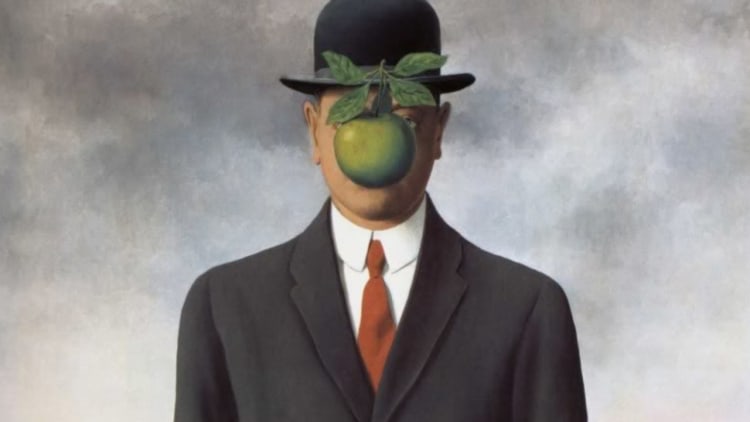
- Magritte & Dalí, for the shifting of reality
- Dubuffet, for organic proliferation
Condo does not imitate — he enters into dialogue with art history.
2 - Entering the exhibition: Inside the artist’s mind
The retrospective opened in a dark, almost suffocating room — a direct plunge into Condo’s inner chaos.
From the very first works, the visitor understands: here, painting is not decorative. It is lived, physical, confrontational.
Deconstructed faces, accumulations of forms, multiplied figures — the works function like psychic chambers.
You don’t look at them — you encounter them.
3 - Controlled chaos: Large formats and visual tension
As the exhibition unfolds, one discovers what many associate with Condo: canvases of striking density, powerful, almost overflowing — yet always perfectly controlled.
This is the essence of his style: an apparent disorder, held firmly in place.
His large-scale works burst with energy, but never collapse into formlessness.
Every tension, every excess, every overflow is considered, adjusted, balanced.
4 - Drawing as the matrix
If painting occupies space, drawing is the engine.
Sketchbooks, loose sheets, quick studies, figures that appear, split, and mutate — here we see that for Condo, drawing is pure thought.
Painting is not improvisation. It is the result of a long visual gestation.
5 - Sculptures: Heavy faces, raw humanity
The sculptures — often overlooked — reveal another side of Condo: Massive heads, sometimes grotesque, always deeply human.
A humanity that is fragile, bruised, lucid.
6 - The black paintings & the return to light
A key moment in the exhibition: the black room. Silence. Material. Presence.
It is difficult not to think of the Rothko Chapel in Houston: not in terms of form, but in what the space makes you feel.
Then, suddenly, the path opens into recent works, radiant with color, light and breath.
Conclusion
This exhibition demonstrates something simple yet essential: Painting is not dead.
It is still capable of moving us, disarming us and reminding us that we are alive.

Painting is very much alive. And George Condo is one of those who keep it living, in all its power and fragility...